Furness Abbey stands as one of the most significant monastic sites in northern England. For more than four centuries, this Cistercian monastery dominated the economy and daily life of the Furness peninsula.
Origins in the Vale of Nightshade
The abbey was founded in 1123, or possibly 1124, by Stephen, Count of Boulogne, who later became King Stephen. The community originally settled at Tulketh near Preston on the banks of the River Ribble, but moved to the Vale of Nightshade in 1127 after just three years. At first the monks followed the Savigniac order; they were absorbed into the Cistercian order in 1147 under Pope Eugenius III.
A Regional Economic Power
Furness Abbey grew to become the second wealthiest Cistercian house in England, surpassed only by Fountains Abbey in Yorkshire. By the time of the Dissolution in 1537, its annual income stood at £805, making it the wealthiest monastery in the north-west. The 1291 papal taxation records show the abbey collected £171 from its manors and estates.
The monks controlled the Furness peninsula economy throughout the Middle Ages. They founded daughter houses at Calder Abbey, Swineshead Abbey, Rushen Abbey on the Isle of Man, and others in Ireland. The abbey owned mines on the Isle of Man and built Piel Castle in 1212 to protect and control trade across the Irish Sea; the castle was fortified in 1327 following Scottish raids.
The Architecture of Power
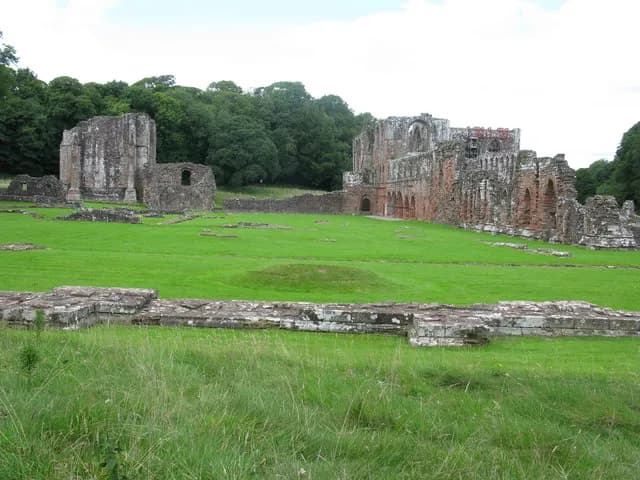
Built entirely of local red sandstone, the abbey ruins reach a maximum height of 40 metres. The church features late 12th-century Gothic transepts and a 15th-century Perpendicular Gothic presbytery, while the nave survives largely at foundation level. The architecture includes unusual alternating circular and eight-shafted piers, which is rare for Cistercian design.
The east range of the cloister remains well preserved, with the first-floor dormitory featuring lancet windows. The 13th-century chapter house contains a vaulted vestibule with paired lancets. The infirmary, dating from the late 13th century, includes an unusual east-end vaulted chapel with near-triangular arches. A reconstructed night stair allows visitors to trace the route monks once used to descend from the dormitory to the church for night services.
War, Plague, and Resilience
The abbey endured significant hardships. Robert the Bruce sacked the monastery in 1316, dispersing the monks for two years. The abbot paid a ransom in 1322 to prevent further damage. The Black Death arrived on 9 August 1349, killing 42 monks and 9 lay brothers.
During the 14th and 15th centuries, the abbey became a pilgrimage site. Approximately 30 bishops issued indulgences for visiting an image of the Virgin Mary, possibly housed in the gatehouse chapel or north transept.
Dissolution and Decline
In spring 1537, Abbot Robert Pyle voluntarily surrendered the abbey to the Crown. The buildings were demolished immediately, though some structures were converted into a manor house. By the 18th century this had become a farm, and from 1847 to 1953 the site operated as the Furness Abbey Hotel, which was demolished in 1953 after sustaining Second World War damage.
Connection to Barrow's Industrial Rise
The abbey's legacy extends directly into Barrow's industrial history. The medieval monks discovered local haematite iron ore deposits; these were rediscovered around 1850 by Henry Schneider, sparking Barrow's transformation into an industrial powerhouse. The Furness Railway, built in 1846 to transport iron ore, followed the economic patterns the monks had established centuries earlier. By 1876, Barrow's steelworks had become the largest in the world.
Visiting Today
Furness Abbey is located on Manor Road in Newbarns, Barrow-in-Furness, just off Abbey Road, which takes its name from the monastery. The site lies 4 miles south-west of Dalton-in-Furness and is adjacent to the Furness Line railway.
English Heritage manages the site, which is open daily from 10am to 5pm with last entry at 4.30pm. The visitor centre displays stone carvings, effigies, the 12th-century silver-gilt Furness Crozier, and an abbot's gemstone ring. Visitors should be aware that mobile phone reception is limited, and winter visits may be affected by flooding. Advance booking saves 15 per cent; English Heritage members enter free.
Cultural Legacy
The abbey has drawn notable visitors for centuries. William Wordsworth referenced it in The Prelude, and J.M.W. Turner produced etchings of the ruins. Queen Victoria and Augusta Stanley visited in 1848. Theodore Roosevelt played on the ruins as a child in 1869, and Chinese statesman Li Hongzhang stayed longer than expected during his 1896 visit.
Local legend adds further colour. Tales speak of three ghostly apparitions: a monk climbing a staircase and entering the gatehouse wall; a squire's daughter on the track known as My Lady's Walk; and a white lady. Stories of tunnels connecting the abbey to Piel Castle and Dalton Castle, said to hide the Holy Grail and King John's jewels, likely derive from confusion with medieval drains.