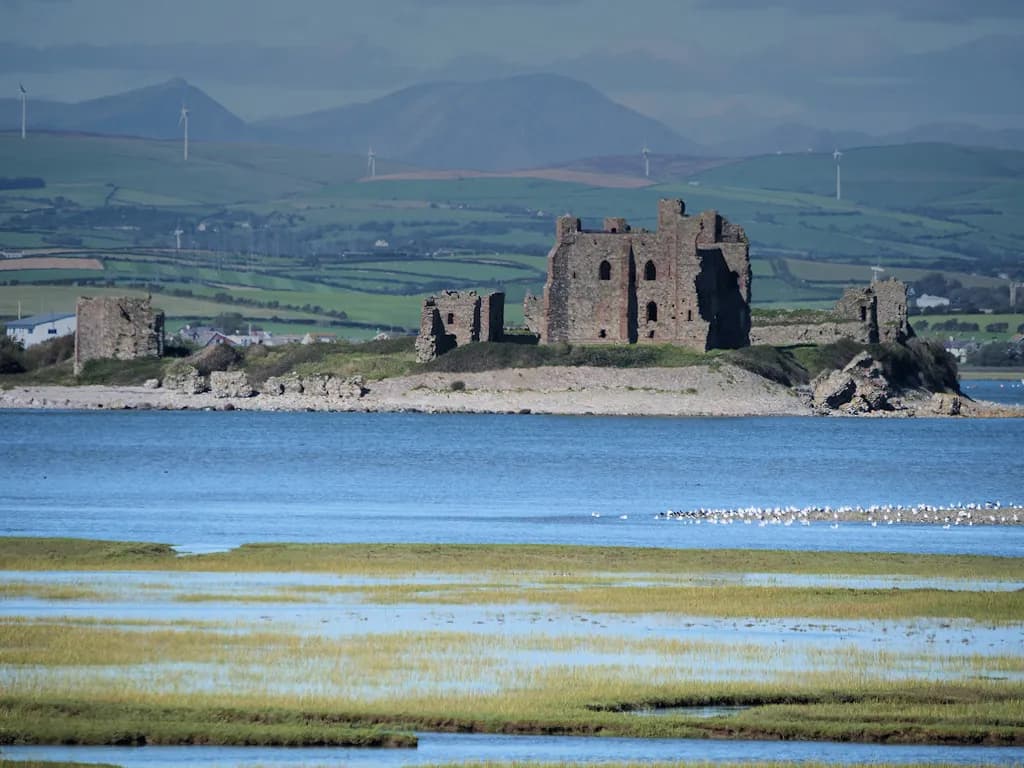
Half a mile off the southern tip of the Furness peninsula lies Piel Island, a modest 50-acre scrap of land that carries the unusual distinction of being both a Site of Special Scientific Interest and home to one of England's more eccentric royal traditions. The island, gifted to the people of Barrow-in-Furness as a First World War memorial, operates under a system of monarchy that has nothing to do with Windsor and everything to do with pub licensing.
The Castle That Started It All
Piel Castle rises from the island's south-eastern shore in partial ruin, a 14th-century fortification built in 1327 by John Cockerham, then Abbot of Furness Abbey. King Edward III granted a licence to crenellate that same year, permitting the abbey to fortify the site against Scottish raiders and pirates plying the Morecambe Bay trade routes.
The castle followed a concentric design, with a three-storey keep measuring 45 feet high and roughly 76 by 74 feet at the base. Constructed largely from beach stones with red sandstone ashlar for finer detailing, it passed to the Crown in 1537 following the Dissolution of the Monasteries. The 5th Duke of Buccleuch undertook extensive restoration between 1877 and 1878, building protective outworks against the sea erosion that continues to threaten the structure today. In September 2022, English Heritage launched a fundraising campaign to address accelerating coastal erosion fuelled by climate change.
Today the castle holds Grade I listed status and remains open to visitors free of charge during daylight hours, though the keep itself is no longer accessible.
A Pretender's Landing
The island's royal associations predate its modern traditions by several centuries. On 4 June 1487, Lambert Simnel, a Yorkist pretender to the English throne, landed on Piel with approximately 2,000 German mercenaries. Simnel held court at the castle before marching inland, only to be defeated at the Battle of Stoke Field on 16 June 1487.
This genuine brush with claimants to the crown provided the historical spark for a tradition that would emerge four centuries later.
The King of Piel
The modern "King of Piel" tradition dates to the 19th century, when a group drinking at the island's sole pub, the Ship Inn, decided that if Simnel could declare himself monarch here, so could they. The tradition evolved into an institutional arrangement: the landlord of the Ship Inn is automatically titled "King" or "Queen" of Piel, with the title formally bestowed by Barrow Borough Council as part of the 10-year lease to operate the pub and manage the island.
The coronation ceremony involves the new landlord sitting upon a wooden throne; an oak chair while alcohol is poured over their head. The BBC has described the proceedings as "a ritualistic ceremony involving lots of alcohol and merriment."
The current monarch, Aaron Sanderson, took possession of the crown in May 2022. Aged 33 and formerly an electrical team leader at BAE Systems Ltd, Sanderson had visited the island since childhood. His coronation was planned for autumn 2022. Previous rulers include Rod and Karen Scarr, who held a 20-year licence until November 2005, and Steve Chattaway, who reigned from 2008 until 2020.
Knighthood for the Price of a Round
The Ship Inn houses another tradition: the Knighthood of Piel. Anyone who sits in the large oak chair within the pub is made a "Knight of Piel," with the ceremony conducted either by the reigning monarch or a fellow knight. The modern cost of this honour is straightforward: the new knight must buy a round of drinks for all present.
The tradition, handed down by fishermen for centuries, carries one curious privilege. Should a knight be shipwrecked upon Piel, they may demand food and lodging from the innkeeper. Whether this right has ever been exercised remains unrecorded.
The Ship Inn
The Ship Inn itself claims origins stretching back more than 300 years, though the earliest direct reference to a "publick house" on the island dates to 1800. The first landlord identifiable with confidence, James Hool, appears in the 1841 census.
The pub serves traditional ales from local breweries alongside standard beers, wines, and spirits. The menu runs to pies, wraps, and jacket potatoes. It opens from March to September, daily weather permitting.
Access and Ownership
Piel Island sits approximately half a mile off the Furness peninsula, accessible via the Piel Ferry, a 12-passenger foot ferry operating from Roa Island daily from Easter through October. Core hours run 11am to 3pm, extended during high summer, though service depends entirely upon weather and tide. A return ticket costs £7 for adults and £5 for children, with under-4s travelling free. Free parking is available at Roa Island by the boat club.
The 7th Duke of Buccleuch gave the island to the people of Barrow-in-Furness in 1920 as a memorial to the fallen of the First World War. Barrow Borough Council remains custodian, with council leader Ann Thomson describing the island as "the jewel in the crown of our borough."
The island's permanent population consists of the landlord and family, plus three residents in the old pilots' cottages. Camping is permitted at £5 per tent with no advance booking required.
Wildlife and Conservation
Beyond its human traditions, Piel serves as a haven for seabirds, with its marsh pond attracting various species. The island's Site of Special Scientific Interest status recognises its ecological importance alongside its historical significance. Seal and birdwatching trips operate from the ferry, offering visitors encounters with the island's non-human inhabitants.
The island presents a curious convergence: medieval military architecture, 19th-century drinking customs, civic stewardship, and natural conservation, all on a strip of land barely visible from the Barrow shore.